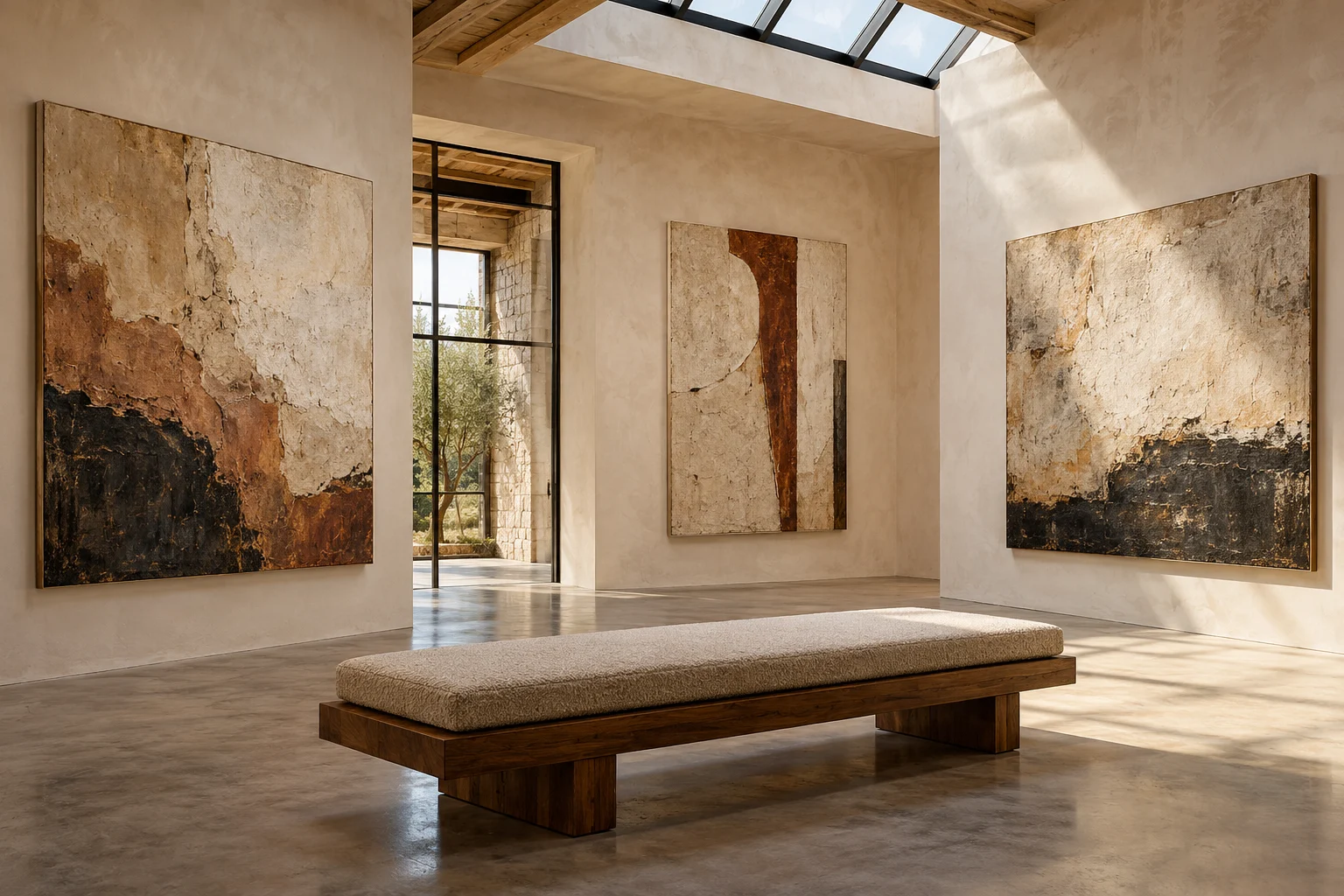
A heavy, textured canvas hangs under a focused spotlight, its surface a chaotic landscape of deep ochre and jagged charcoal strokes. There is a certain weight to the brushwork that feels almost tactile, as if the movement of the artist’s arm remains visible in the dried pigment. Standing before it, one might feel a sense of restless energy or perhaps a quiet, somber stillness. These are immediate, sensory responses—the raw data of the eyes and the gut.
The Tension of the Written Word
As you move closer, a small white card mounted beside the frame offers a different perspective. It describes the piece not as a landscape of energy, but as a study in industrial decay, citing the artist's intent to critique urban expansion. Suddenly, the visual evidence you gathered is placed in direct conversation with a formal narrative. This creates a distinct tension: the difference between what the work is to the viewer and what the creator claims it to be.
Navigating an exhibition often involves managing several conflicting streams of information. You have the physical presence of the object, the historical context provided by museum guides, the curated themes of the gallery itself, and the specific intentions printed on the wall. Each source offers a piece of the puzzle, yet they do not always fit together into a single, seamless picture.
Balancing Perception and Intent
For many, the presence of a formal explanation feels like a test with a correct answer. There is a temptation to discard one's own reaction if it does not align with the academic description. However, the value of an outing lies in the tradeoff between these two modes of engagement. If you rely solely on your eyes, you might miss the historical nuances that give the work depth. If you rely solely on the text, you risk treating the art as a mere illustration of a lecture, losing the visceral connection that makes the encounter worthwhile.
For example, if you are standing before a minimalist sculpture made of polished steel, the gallery text might discuss the concept of infinite reflection and the void. Your own observation, however, might be focused on how the cool metal temperature shifts the atmosphere of the room or how the light hits a specific corner. Neither observation is incorrect; they are simply different ways of witnessing the same object.
Cultivating a Personal Dialogue
Instead of seeking a consensus between the plaque and your pulse, try treating the written word as a suggestion rather than a verdict. Use the information to expand your inquiry rather than to close it. If a description mentions a specific period or technique, ask yourself how that knowledge changes—or fails to change—your initial physical reaction. By acknowledging the gap between the artist's intent and your own perception, you transform a passive viewing into an active, personal investigation.